
MacConkey Agar: Principle, Uses and Preparation
MacConkey Agar is used to grow Gram negative bacteria and completely inhibits Gram positive bacteria. The principle behind this lies in the composition. Bile salts present in the agar can easily disrupt the cell membrane of Gram positive bacteria whereas crystal violet binds to the cell wall, penetrates the cell and disrupts the cellular function.
6/8/20262 min read
MacConkey Agar is used to grow Gram negative bacteria and completely inhibits Gram positive bacteria. The principle behind this lies in the composition. Bile salts present in the agar can easily disrupt the cell membrane of Gram positive bacteria whereas crystal violet binds to the cell wall, penetrates the cell and disrupts the cellular function.
Principle of MacConkey Agar
Beyond basic nutritional ingredients needed to support the growth of bacteria, MacConkey agar is designed with few more ingredients that allows it for the selective growth of Gram negative bacteria only.
Let’s have a closer look:
Selective Ingredients Bile Salts and Crystal Violet:
First, we need to know about the composition of Gram positive bacteria and Gram negative cell structure. Gram negative bacteria have an outer membrane which acts as a barrier and does not allow bile salts to penetrate its structure easily. However, the case is different in Gram positive bacteria. Due to sensitive outer structure, bile salts easily penetrate its cell wall, leaking the content inside hence completely stopping its metabolism.
Crystal violet adds to this effect. It has an inhibitory effect and inhibits the metabolic processes in Gram positive bacteria. Hence, bile salts and crystal violet used in MacConkey agar selectively inhibits the growth of Gram positive bacteria.
Differential Ingredients Lactose and Neutral Red:
Lactose is a disaccharide, a carbohydrate source utilized only by certain group of bacteria. Among the Gram negative bacteria that grows in the MacConkey agar, only coliforms can utilize it.
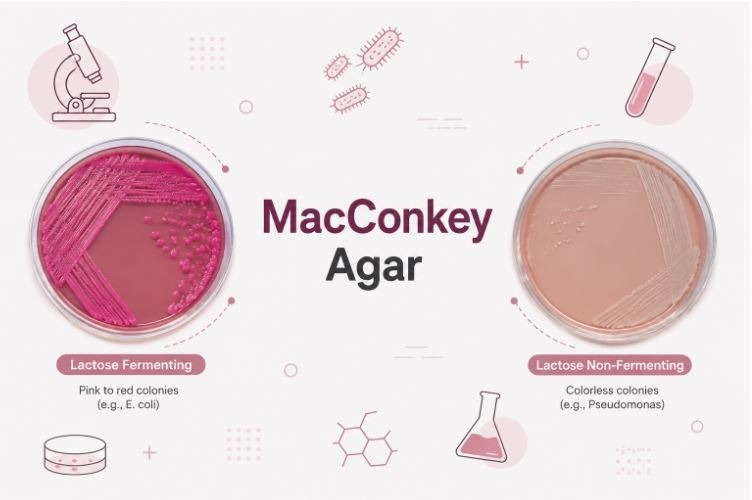
If lactose is utilized by the bacteria and the acidic byproducts are released, pH indicator neutral red used in the media turns into the same color as the growing colonies, which is pinkish or reddish. But on the hind side, if no lactose is utilized the colonies are generally pale.
Note: Lactose fermenting bacteria can utilize lactose as their potential substrate which is true for the coliform group of bacteria. On the other hand, bacteria like Salmonella spp., Shigella spp., Proteus spp., and Pseudomonas aeruginosa can not metabolize lactose and are classified as lactose non fermenting bacteria.
Lactose Fermenting vs Non-Lactose Fermenting Bacteria on MacConkey Agar
Composition of MacConkey Agar
Gelatin peptone
Tryptone
Peptone
Lactose
Bile salts
Sodium chloride
Neutral Red
Crystal violet
Agar
References
Chakraborty, P. (2022). A textbook of microbiology (3rd ed.). New Central Book Agency.
Parija SC. Textbook of Microbiology and Immunology. 3rd ed. New Delhi: Elsevier India; 2016.
Textbook of Medical Microbiology. New Delhi: Jaypee Brothers Medical Publishers.
Textbook of Microbiology. Hyderabad: Universities Press
Steps to Prepare MacConkey Agar
Introduce weighed 50 grams of the blood agar powder in 1000 ml of distilled water.
Let the mix boil, make sure the agar dissolves completely.
For sterilization, autoclave the media. Standard: maintain 15 lbs pressure for 15 minutes at pressure 15 lbs.
After removing from the autoclave, let the agar come to a temperature of 45-50°C.
Give a proper and slow shake to the conical flask you have prepared on.
Now, it’s time to plate the agar. Under strict aseptic conditions, pour into sterile petriplates. Maintain a depth of 3 to 5 mm.
Let the plate dry and it’s ready to use. If you have excess plates or tend to use it later on, store properly in a refrigerator.
Uses of MacConkey Agar Media
MacConkey agar is mainly used as a selective and differential media. Its main uses are:
Selective growth: MacConkey agar selectives support the growth of Gram negative bacteria and completely prevent the growth of Gram positive ones. It is used in the routine laboratory identification of Gram negative bacteria in various clinical isolates.
Differential media: MacConkey agar is also used to differentiate lactose fermenting from lactose non-fermenting Gram negative bacteria. This property of the media especially helps to separate enteric pathogens/coliforms (family Enterobacteriaceae) in clinical, environmental, food, and water samples.