Introduction to Transfusion Medicine

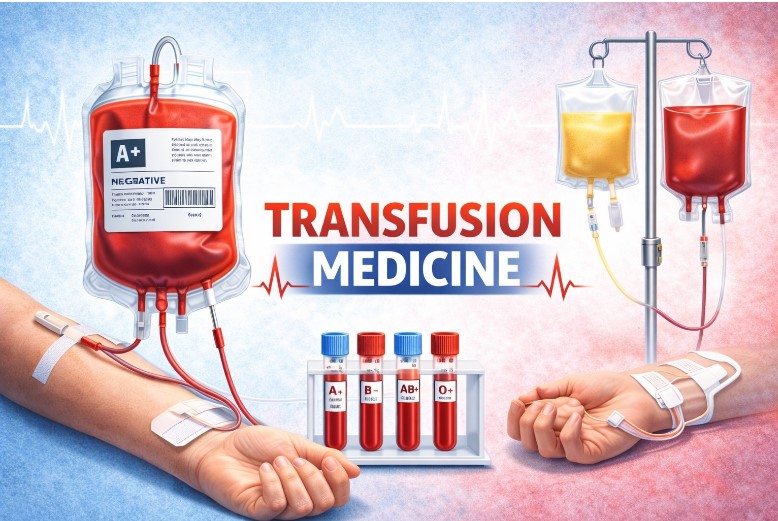
Transfusion medicine is a specialized medical field focused on collecting, processing, testing, storing, and transfusing blood and blood components (like red cells, platelets, plasma) for therapeutic uses, ensuring safety and efficacy for patients needing surgery, trauma care, cancer treatment, or managing blood disorders, incorporating lab science (immunohematology, blood banking) and clinical practice, including newer cellular therapies.

12/21/20256 min read

Transfusion medicine is a sub-specialty of clinical pathology and deals with the collection, processing, testing, storage, and administration of blood and blood components. This is what makes this system safe and reliable the moment you enter a blood bank and start working. It is not merely the matter of mere blood transfusion, surgery, trauma care, hematology, oncology, obstetrics, and critical care; the critical coordination of these services is what must be incorporated into patient management. The end result is the safe and effective practice of transfusion through the knowledge of immunohematology, blood group systems, compatibility testing, donor screening, and transfusion reactions.

A full knowledge of human blood group systems is an essential basis of transfusion medicine. Being a medical student, you must be aware of genetically determined antigens that exist on the surface of red blood cells (RBCs), since the risk that accompanies mismatches, leading to severe hemolytic transfusion reactions, is potentially fatal. The International Society of Blood Transfusion (ISBT) has identified over 45 blood group systems and over 360 antigens, but few of them are of major clinical importance, and any person in a hospital should be aware of ABO blood group and Rh blood group system.
Overview of Blood Group Systems

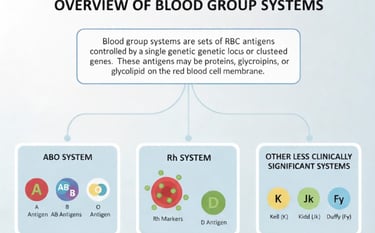
Blood group systems are defined based on a set of antigens controlled by a single genetic locus or a cluster of closely linked genes. These antigens are typically proteins, glycoproteins, or glycolipids found on the RBC membrane. Among all systems, the ABO and Rh systems are the most important due to their high immunogenicity and widespread clinical implications.

The ABO Blood Group System

Introduction

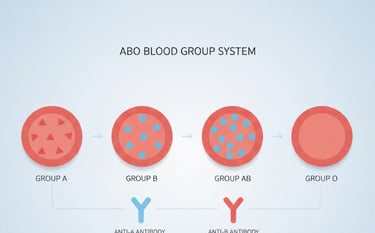
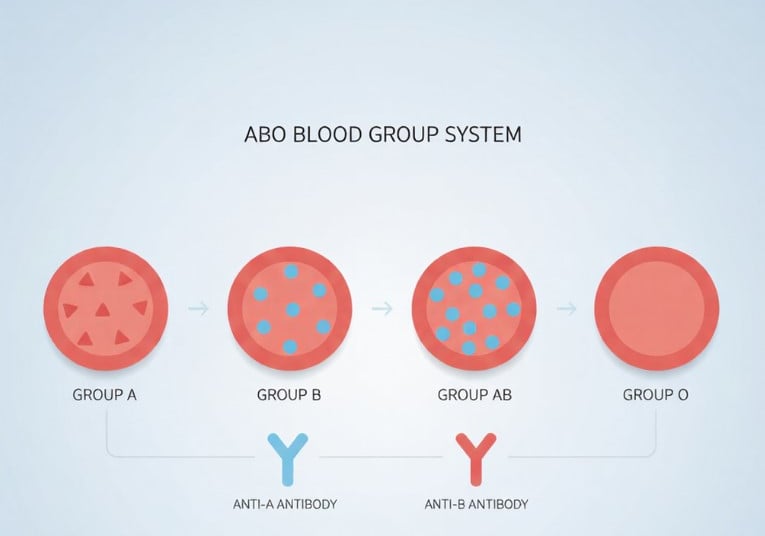
The ABO system, was discovered by Karl Landsteiner in 1901, and is the most critical blood group system in transfusion medicine. It consists of four main blood groups: A, B, AB, and O, based on the presence or absence of A and B antigens on RBCs.

Genetics and Inheritance

  • The ABO gene is located on chromosome 9q34.

  • Three main alleles: A, B, and O.

  • A and B alleles are codominant; O is recessive.


Antigen and Antibody in Each Blood Group

Blood Group (Phenotype) RBC Antigens Present Plasma Antibodies Present Possible Genotypes

A A antigen Anti-B AA, AO

B B antigen Anti-A BB, BO

AB A and B antigens None AB

O No A or B antigens Anti-A and Anti-B OO

Blood Group A

A antigen appears on the surface of red blood cells of people who have blood group A and anti-B antibodies are naturally produced, which are mostly of IgM type and occasionally IgG. They can be AA or AO and clinically they are not to be administered with B antigen blood that is, they are to be administered only with A or O blood.


Blood Group B

B antigen is found on the RBCs of individuals with blood group B and they naturally produce anti-A antibodies which too are predominantly IgM. They are genotype BB or BO and can safely receive B or O blood but not A or AB due to the anti-A antibodies.


Blood Group AB

The AB people are those who possess both the A and B antigens and therefore do not possess natural anti-A or anti-B antibodies in their plasma. Their genotype is AB and as they lack the isoagglutinins, they are considered to be the universal recipients of the red cell transfusion.

Blood Group O

On the other hand, the blood group O individuals do not have any A or B antigens on the RBCs but produce both anti-A and anti-B antibodies, typically strong IgM antibodies that can cause rapid hemolysis in case of incompatible transfusion. They possess OO genotype and they are the universal donor of RBCs but they only receive O blood since they have both antibodies. Such antigen-antibody interactions and genotypes are significant to learn so that transfusion activities can be safe and acute hemolytic reactions can be prevented.

Biochemistry of ABO Antigens

  • A and B antigens are carbohydrate structures attached to lipid or protein backbones.

  • The H antigen serves as a precursor.

  • A allele adds N-acetylgalactosamine;
    B allele adds galactose;
    O allele adds no sugar, leaving the H antigen unchanged.

A Reminder: Naturally Occurring Antibodies

A key feature of the ABO system is the presence of naturally occurring IgM antibodies against the antigens absent on an individual's RBCs.

  • Group A → anti-B

  • Group B → anti-A

  • Group O → anti-A and anti-B

  • Group AB → no ABO antibodies

These antibodies can activate complement and cause rapid, severe intravascular hemolysis if incompatible transfusions occur.

Subgroups

The A subgroups are variations within the A blood group that differ in the amount and type of A antigen expressed on the surface of red blood cells. Although all individuals with these subgroups belong to blood group A, the strength of antigen expression is not the same in every person. The two most common subgroups are A1 and A2, with A1 found in about 80% of group A individuals and A2 in about 20%. A1 red blood cells carry a very high number of A antigen sites, whereas A2 and other less common subgroups cells carry fewer, which can sometimes result in slightly weaker reactions during blood typing.

  • A1 (80%)

  • A2 (20%)

  • Rare: A3, Ax, Am, etc.

Clinical Significance

What we need to know in transfusion medicine is that ABO incompatibility is the most dangerous mistake possible in a blood transfusion. It is one of the quickest fatal complications that can be experienced in clinical practice because a mismatch can cause an acute hemolytic transfusion reaction within minutes. The error occurs because the ABO antibodies are naturally occurring and very powerful, especially the IgM antibodies which respond immediately when incompatible red cells are injected into the circulation. The significance of the ABO system is not limited to transfusion either, and it is also a very important factor in organ transplantation, with an ABO mismatch leading to an immediate graft rejection. This is what makes the understanding of the ABO system a prerequisite to safety in transfusion as well as transplantation.

Rh Blood Group System

The Rh system is the second most important blood group system. The most important antigen in this system is D, commonly referred to as “Rh factor.”

The D antigen, the most important and clinically significant antigen in the Rh blood group system, is present on the surface of red blood cells just like A, B, and O antigens in the ABO system, but the Rh system differs because the D antigen only determines positive or negative, not the basic blood group.

The presence or absence of D antigen determines whether a person is classified as Rh positive or Rh negative.

The D antigen is encoded by the RHD gene, which is located on chromosome 1 alongside the RHCE gene that produces the C, c, E, and e antigens.

  • RHD gene → D antigen

  • RHCE gene → C, c, E, e antigens

The presence of D antigen → Rh positive;
Absence → Rh negative.

Individuals who inherit a functional RHD gene express the D antigen on their red blood cells and are therefore Rh positive, while those who lack the RHD gene- or have a nonfunctional version of it- do not express the D antigen and are considered Rh negative. The D antigen is highly immunogenic, meaning that Rh-negative individuals can easily form anti-D antibodies if exposed to Rh-positive blood through transfusion or pregnancy.

Because these antibodies can cause serious hemolytic reactions and hemolytic disease of the fetus and newborn (HDFN), understanding the genetics and expression of the D antigen is crucial in transfusion medicine and obstetric care. In the ABO system, antibodies are naturally present from birth, but in the Rh system (D antigen), antibodies develop only after exposure to D-positive blood. Rh (anti-D) reactions are generally more severe, especially in pregnancy, because anti-D antibodies can easily cross the placenta and cause serious HDFN. ABO reactions can also be dangerous, but the Rh system is usually more critical in pregnancy, while both ABO and Rh systems are essential for safe blood transfusions.

Immunogenicity

The D antigen is highly immunogenic, second only to ABO antigens. Exposure to as little as 0.1 mL of D-positive blood can stimulate anti-D production in Rh-negative individuals.

Antibody Characteristics

  • Anti-D is usually an IgG antibody.

  • Capable of crossing the placenta.

  • Causes Hemolytic Disease of the Fetus and Newborn (HDFN).


Clinical Significance

Rh compatibility is essential in transfusions and pregnancy management.
Rh immune globulin (RhIg) is used to prevent alloimmunization in Rh-negative mothers.


Phenotype Rh Antigen on RBC Naturally Occurring Antibodies? Antibody Produced After Exposure Possible Genotypes

Rh-positive D antigen present None — DD, Dd

(Rh⁺)

Rh-negative No D antigen None (antibody not Anti-D, produced after sensitization dd

(Rh⁻) naturally occurring) (pregnancy or transfusion)

References

  1. ABBAS, A.K., LICHTMAN, A.H., & PILLAI, S.

Cellular and Molecular Immunology, 10th ed. Elsevier

  1. HARMENING, D.

Modern Blood Banking & Transfusion Practices, 7th ed.

  1. STANLEY L. SCHIFF'S Hematology in Clinical Practice, 6th ed.

  2. Daniels, G.

“Human Blood Groups.” British Journal of Haematology.