Introduction to Leukemia
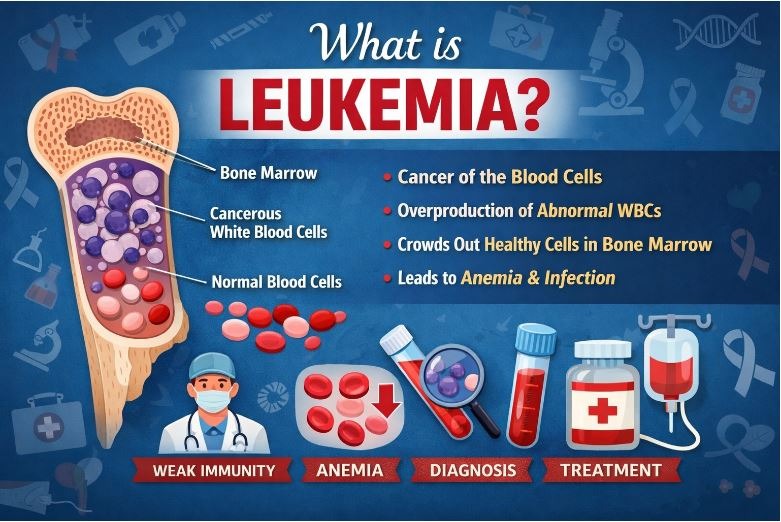
Leukemia refers to the cancer of blood cells and tissues involved in general terms. It usually starts from bone marrow due to the mutation in genes. Bone marrow is the site for the production of the blood cells. These blood cells are produced and passed in circulation for various functions. Overproduction of immature white blood cells is the most common outcome of leukemia. It directly affects the immune system of the body as WBCs are primary cells contributing to immunity.
1/18/20262 min read
Leukemia refers to the cancer of blood cells and tissues involved in general terms. It usually starts from bone marrow due to the mutation in genes. Bone marrow is the site for the production of the blood cells. These blood cells are produced and passed in circulation for various functions. Overproduction of immature white blood cells is the most common outcome of leukemia. It directly affects the immune system of the body as WBCs are primary cells contributing to immunity.
Classification of leukemia
Leukemia can be classified on the basis of the speed of spreading of the condition and on the basis of the cells involved.
By speed of spreading:
Acute Leukemia: It is characterized by rapid division of cells in bone marrow causing quick progression of the condition. It can be fatal and requires immediate medical attention. It can be seen more common in children
Chronic leukemia: It is characterized by slow progression in comparison to the acute one. It may not have symptoms that is commonly noticeable over long period of time due to slow progression. It can be seen to be more common in adults.
By the type of cells involved:
Myeloid leukemia: It involves myeloid cells which in normal condition grow into red blood cells, white blood cells and platelets.
Lymphoid leukemia: It involves lymphoid cells which develop into a kind of white blood cells. These white blood cells are important part of immune system.
Types of leukemia:
On the basis of this classification, leukemia can be divided into four major different types and more subtypes.
1. Acute lymphoid leukemia
2. Acute myeloid leukemia
3. Chronic lymphoid leukemia
4. Chronic myeloid leukemia
General signs and symptoms
· Recurrent Infections
· Tiredness
· Fever
· Swollen lymphatic systems mainly lymph nodes and enlarged spleen
· Weight loss
· Difficulty breathing
· Bleeding and bruising more often
Risk Factors
· Exposure to harmful chemicals
· Smoking
· Family history of leukemia
· Genetic disorder
Diagnosis
· Noting of the persistent symptoms matching leukemia.
· Ultrasonography of the swollen lymph nodes and enlarged spleen.
· Laboratory examination: Comple blood cell count to know abnormal levels of blood cells in circulation. Typically, CBC is characterized by high number of WBCs. Further Peripheral blood smear can be performed to visualize the type, size and shape of the cells present in blood.
· Bone marrow biopsy: The biopsy is taken for examination of cells present in bone marrow under microscope. leukemia is characterized by abnormal cells crowding the spaces of bone marrow.
Treatment
The treatment plan of leukemia depends on the type of leukemia and the symptoms seen. Some major treatment followed in case of leukemia are:
· Chemotherapy: Here, the drugs are used to kill cancer cells which are dividing continuously and rapidly. It can be given through oral, intravenous or intrathecal routes.
· Immunotherapy: Here, the immune system of one's body is initiated to find and kill the cancer cells that are growing inside the body.
· Radiotherapy: Here radiation is used to damage cancer cells in case of metastasis of leukemia to other parts of the body.
· Bone marrow transplant: Here, unhealthy bone marrow or stem cells are replaced by healthy ones by transplantation. It involves challenges like the matching of donor bone marrow with the receptor.
References
National Heart, Lung, and Blood Institute (NHLBI). Leukemia. https://www.nhlbi.nih.gov/health/leukemia
Hoffbrand, A. V., Higgs, D. R., Keeling, D. M., Mehta, A. B. Postgraduate Haematology. 8th ed. Wiley-Blackwell; 2019.
American Cancer Society. What Is Leukemia? https://www.cancer.org/cancer/leukemia.html