
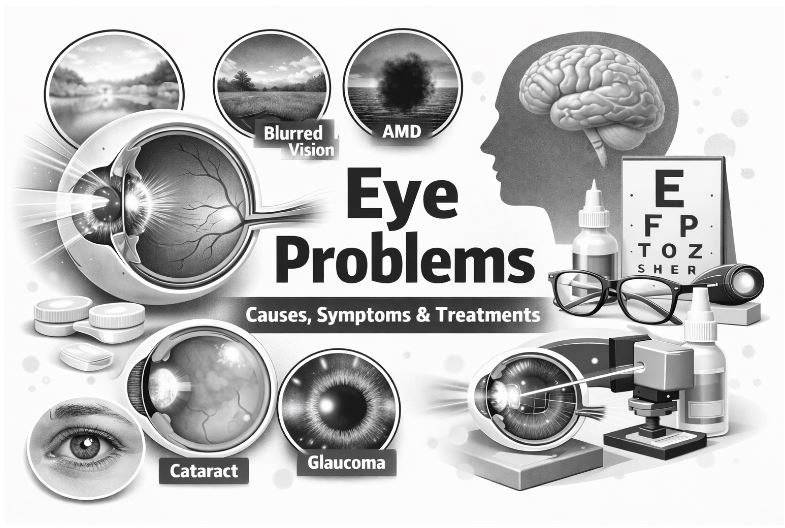
Common Eye Problems and Symptoms
The eye is one of the sense organs whose main function is to capture and focus light converting it into an electrical signal which can be sent to the brain. The optic nerve sends those signal which allows us to see colors, shapes and depth by further processing that happens in the brain.
3/21/20264 min read
The eye is one of the sense organs whose main function is to capture and focus light converting it into an electrical signal which can be sent to the brain. The optic nerve sends those signal which allows us to see colors, shapes and depth by further processing that happens in the brain.
Refractive error
This is a common vision issue occurring in a large population. Major types of common vision issues due to refractive error are:
· Nearsightedness: Here, vision is blurred for faraway objects
· Farsightedness: Here, vision is blurred for nearer objects
· Astigmatism: Here, vision is distorted or blurred at all distances
· Presbyopia: It often begins around age 45 where seeing things up close becomes challenging.
Symptoms:
· Blurred vision is the most common symptom
· Eyes strains
· Headaches
· Glaring seen around brighter things
· Late focusing when reading or while looking at digital displays
Treatment:
· Glasses (convex, concave or mixed according to need)
· Contact lenses
· Laser eye surgery in certain cases
Age-related Macular Degeneration
It can be abbreviated as AMD which is due to damaged sharp and central vision among older adults. It affects the central part of the retina also called the macula which helps in detailed and sharp vision. Here, peripheral vision is not affected so it doesn’t cause complete blindness. It can be of two types:
· Wet AMD: It is less common where the damage is caused by leakage of blood and fluid by the growth of abnormal blood vessels. Though less common, it required immediate medical attention to prevent further vision loss.
· Dry AMD: It is the most common type of AMD (above 70%) where the macula thins over time. It causes a gradual blurring of central vision.
Symptoms:
· Blurry central vision
· Empty spots
· Wavy vision
· Fading colors
Treatment:
· Drugs to stop leaking from blood vessels
· Photodynamic therapy
· Laser surgery
· Healthy Lifestyle and diet
Cataract
It is the clouding of the eye lens due to protein clumping. It is the leading cause of blindness worldwide. It can be present at birth or can occur at any age. The major causes are ageing, UV exposure, eye trauma, and medical conditions such as eczema, diabetes mellitus.
Symptoms:
· Cloudy pupil
· Blurred vision
· Faded colors double vision
· Low light vision problems
Treatment:
· Prescribed glasses (early stage)
· Cataract surgery
Diabetic retinopathy
It is another leading cause of blindness which is a serious complication of diabetes. It is the progressive damage to the blood vessels present in the retina of the eye. The progression of the retinopathy happens in four stages:
· Mild non-proliferative retinopathy: small swelling areas
· Moderate non-proliferative retinopathy: a few retinal vessels are blocked
· Severe non-proliferative retinopathy: more retinal vessels are blocked, leading to the formation of new blood vessels
· Proliferative retinopathy: advanced stage causing full blindness
Symptoms:
· Empty areas or dark spots within the line of vision
· Altering vision
· Vision loss
· Color vision reduction
Treatment:
· Management of blood sugar/ pressure
· Drugs like anti-VEGF, steroids for swelling
· Laser therapy
· Surgery
Glaucoma
It is the damage of optic nerve leading to vision loss and blindness. It might be due to the rise in fluid pressure inside the eyes.
· Open angle: It is a chronic condition that progresses over time.
· Angle closure: It is sudden and painful in nature.
Symptoms:
· Blurred vision
· Rainbow vision in bright lights
Treatment:
· Medication to reduce nerve damage
· Laser treatment
· Surgery
Amblyopia
It is also known as lazy eye, where the eye and brain working in synchronization aren’t met for both eyes together. The brain favors one eye resulting in this condition. Here eye itself looks normal.
Symptoms:
· Turning in and out of the eyes
· Inability to judge depth correctly
· Poor vision in one eye
Treatment:
· Treatment includes cataract surgery or refractive error maintenance if needed in the lazy eye
· Patch placement on the normal eye to synchronize the affected eye and brain
Strabismus
It is due to the imbalanced position of the two eyes. Here, the coordination between the two eyes isn’t met. Both eyes can’t focus on a single point simultaneously.
Symptoms:
· Visible misaligned eyes
· Double vision
· Eye strain
· Headaches
· Uncoordinated eye movements
Treatment:
· Glasses
· Prism lenses
· Eye muscle surgery
· Vision therapy
Home remedies for the betterment of the eye and the prevention of eye problems:
Getting checked and treated is always an option when the problem occurs but certain remedies can be followed even in a home setup or in daily routines for the betterment of eye health. The simple eye care tips or remedies that can be easily followed are given below:
· Drinking enough water to stay hydrated.
· Following 20-20-20 rule.
· Wearing Sunglasses in bright light, sun and polluted areas.
· Having enough sleep daily.
· Having healthy diets specialized for eye.
· Practicing simple Eye Exercises.
· Maintaining Proper Lighting.
· Avoiding the habit of Smoking.
· Taking breaks from the prolonged screen time or reading
Even an eye problem might that tend to look like nothing can end big if it’s not cured as per need. So, if any problem arises, it’s always better to take proper advice from the specialized eye physicians in the nearest and reliable health care setup.
References
Wang, Y.-H., Huang, C., Tseng, Y.-L., Zhong, J., & Li, X.-M. (2021). Refractive error and eye health: An umbrella review of meta-analyses. Frontiers in Medicine, 8, 759767. https://doi.org/10.3389/fmed.2021.759767
Albert, D. M., & Jakobiec, F. A. (Eds.). (2014). Principles and practice of ophthalmology (3rd ed.). Saunders.
Galloway, N. R., Amoaku, W. M. K., Galloway, P. H., & Browning, A. C. (Eds.). (2022). Common eye diseases and their management (5th ed.). Springer.